
Quick answer: A baseball logic puzzle is a sports-themed deduction challenge that uses clues about players, teams, scores, positions, or games. Solve it by listing the facts, eliminating impossible matches, and checking that every final answer fits the clues.
Introduction
A baseball for beginners logic puzzle is a fun brain teaser that brings the world of baseball into a clue-based puzzle format. Instead of only watching a game, checking scores, or following player stats, this type of puzzle asks you to think carefully and use logic to find the correct answer.
In a baseball logic puzzle, the clues may include players, teams, positions, jersey numbers, scores, innings, stadiums, or batting order. The goal is usually to match the right details together. For example, you may need to find which player was the pitcher, which team scored five runs, or which batter played third in the lineup.
What makes this puzzle enjoyable is its simple but smart structure. You do not need to guess. You read the clues, remove the wrong options, and slowly move toward the answer. That step-by-step process is what makes logic puzzles satisfying for many puzzle lovers.
Baseball is also a strong theme for puzzles because the game already has many organized parts. There are players, teams, field positions, innings, runs, and match results. These details can easily become clues, which makes the puzzle feel natural and interesting.
A baseball logic puzzle can be easy for beginners or more challenging for experienced solvers. Some puzzles may have only three players and three positions. Others may include several teams, scores, numbers, and game schedules. The main idea remains the same: follow the clues and solve the puzzle with clear thinking.
Quick Facts About Baseball Logic Puzzle
| Box | Details |
|---|---|
| Topic | Baseball Logic Puzzle |
| Puzzle Type | Clue-based logic puzzle |
| Main Theme | Baseball, players, teams, and positions |
| Best For | Puzzle lovers, students, teachers, and sports fans |
| Difficulty Level | Easy to advanced |
| Common Details | Players, teams, scores, innings, jersey numbers |
| Main Skill | Logical reasoning |
| Helpful Tool | Logic grid or simple table |
| Learning Value | Improves focus, patience, and problem-solving |
| Beginner Friendly | Yes |
| Play Style | Read clues and match correct answers |
| Good For Classroom | Yes, as a thinking activity |
What Is a Baseball Logic Puzzle?
A baseball logic grid puzzle is a themed puzzle where the solver uses clues to connect baseball-related details. These details can include player names, team names, positions, jersey numbers, scores, or game results.
For example, a puzzle may give you four players and four positions: pitcher, catcher, shortstop, and batter. The clues may tell you that one player was not the pitcher, another wore number 12, and the catcher played for a certain team. Your job is to use these clues to find the correct match for every player.
The puzzle is usually solved through deduction. This means you work out the answer by removing what cannot be true and keeping what must be true. If one clue says that Adam was not the catcher, then catcher can be removed from Adam’s possible answers. If another clue says that the player wearing number 9 was the pitcher, then number 9 and pitcher must belong together.
This makes the puzzle more thoughtful than a simple guessing game. A good baseball logic puzzle gives enough clues for the solver to find one clear answer.
Why Baseball Fits Logic Puzzles
Baseball works well for logic puzzles because it has many clear categories. Every player has a role. Each team can have a score. every game has innings. Each batter may appear in a certain order. These parts make it easy to create clues that are simple to read but still require careful thinking.
For example, a clue may say:
The player who wore number 7 was not the catcher.
Another clue may say:
The Tigers scored more runs than the Bears.
A third clue may say:
The pitcher batted before the shortstop.
Each clue gives a small piece of information. Alone, one clue may not solve the full puzzle. But when several clues are used together, the answer begins to appear.
This is why baseball logic puzzles are enjoyable for puzzle lovers. They feel like a small mystery. You are not just filling boxes. You are solving a baseball-themed problem one clue at a time.
How It Usually Works
Most baseball logic puzzles begin with a short setup. The puzzle may say that four players took part in a friendly baseball game. Each player had a different position, wore a different jersey number, and played for a different team.
Then the puzzle gives clues. These clues may be direct, negative, comparative, or order-based.
A direct clue gives clear information. For example:
Bilal was the pitcher.
A negative clue removes an option. For example:
Hamza was not the catcher.
A comparative clue compares two details. For example:
The Lions scored more runs than the Hawks.
An order clue uses sequence. For example:
The player wearing number 10 batted before the player wearing number 4.
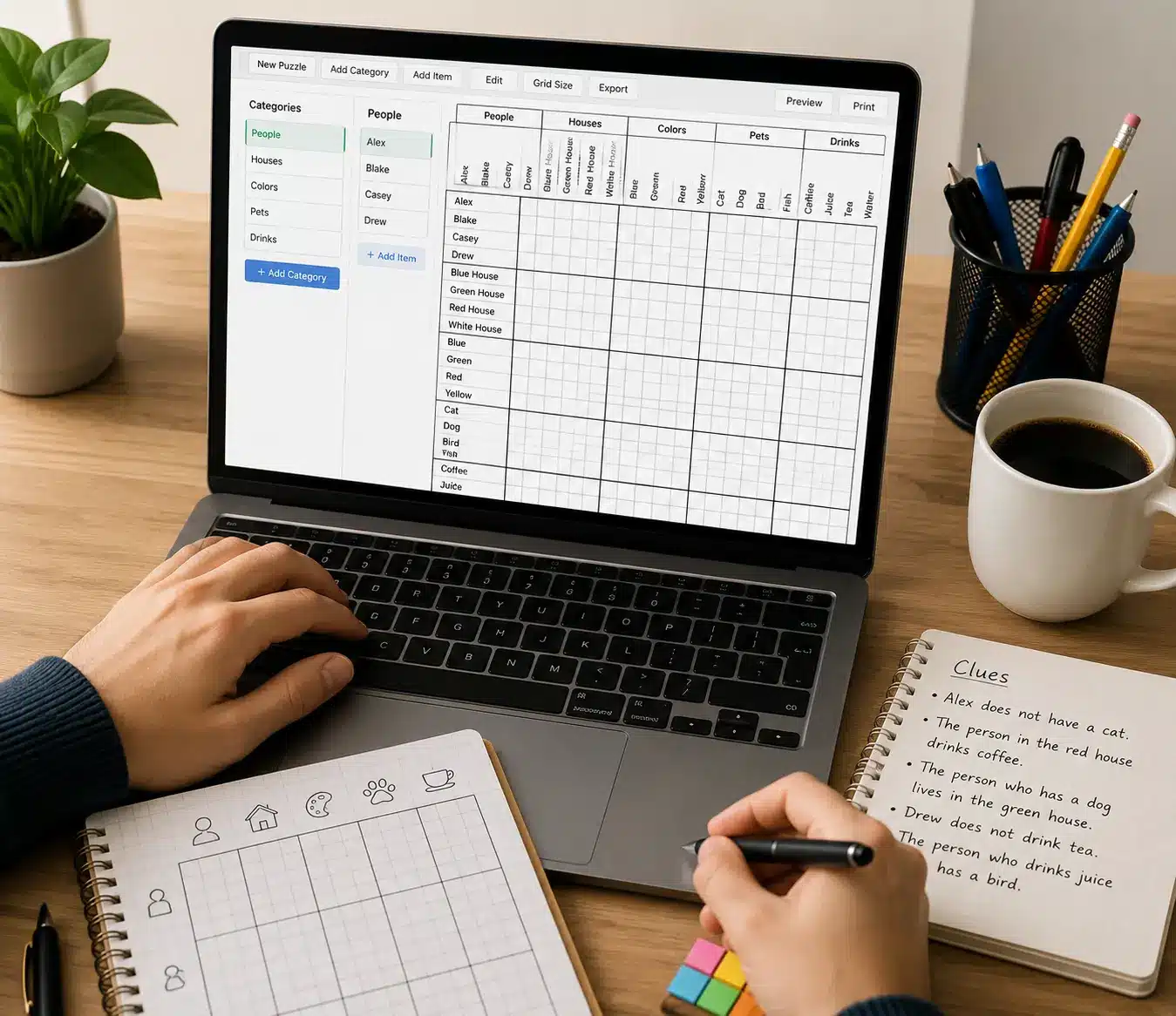
The solver reads each clue and starts marking what is true and what is not true. Many solvers use a logic grid because it keeps the information organized. A grid helps you cross out wrong choices and mark correct matches.
The best way to solve a baseball logic puzzle is to stay calm and move step by step. If you want to understand the process more clearly, this guide on solving logic puzzles can help you practice calm, structured thinking before trying harder baseball-themed clues.
Common Puzzle Details
A baseball logic puzzle can include many different details. The most common ones are players, teams, positions, jersey numbers, scores, innings, stadiums, and batting order.
Player names make the puzzle feel personal. Team names create a sense of competition. Positions add a real baseball feeling. Jersey numbers make the clues more specific. Scores add light number reasoning. Innings create time-based clues. Batting order creates sequence-based thinking.
A simple puzzle may ask:
Who was the pitcher?
Which player wore number 12?
Which team scored the most runs?
Who batted first?
Which player belonged to the Tigers?
These details are easy to understand, but they can still create an interesting challenge. A good puzzle does not need to be overly complicated. It only needs clear clues and a fair solution.
A Simple Example
Here is a small example of a baseball logic puzzle.
Three players — Omar, Bilal, and Daniyal — played three different positions: pitcher, catcher, and batter.
Clues:
Omar was not the pitcher.
Bilal was not the catcher.
Daniyal was the pitcher.
Now solve it step by step.
Since Daniyal was the pitcher, Omar and Bilal cannot be the pitcher. Bilal was not the catcher, and he also cannot be the pitcher because Daniyal already has that position. So Bilal must be the batter.
That leaves Omar as the catcher.
Final answer:
Daniyal = Pitcher
Bilal = Batter
Omar = Catcher
This example is very simple, but it shows the main idea. You do not guess the answer. You follow the clues until each option fits correctly.
Why Puzzle Lovers Enjoy It

Puzzle lovers enjoy baseball logic puzzles because they combine structure, challenge, and discovery. Every clue matters. Every wrong option you remove brings you closer to the answer.
There is also a nice feeling when one clue suddenly unlocks another. At first, the puzzle may seem confusing. Then one clear connection appears. After that, the solution starts moving faster. This “aha” moment is one of the best parts of solving logic puzzles.
The baseball theme adds more personality to the puzzle. Instead of solving a plain chart, you are working through a small sports mystery. Who played shortstop? Which team won? Who wore number 21? Which player batted first?
This makes the puzzle feel active and enjoyable. For baseball fans, the theme feels familiar. For puzzle lovers, the clue structure feels satisfying.
Benefits of Baseball Logic Puzzles
A baseball logic puzzle is not only fun. It can also help build useful thinking skills.
Logic puzzles are often used to support step-by-step thinking. Practical Primary Teacher notes that logic puzzles can encourage students to use reasoning, elimination, and working backward while solving problems.
The first benefit is logical reasoning. The solver learns how to connect clues and make decisions based on information. Instead of choosing an answer quickly, the solver checks what each clue proves.
The second benefit is attention to detail. Small words can change the meaning of a clue. Words like not, before, after, more than, and less than are very important. Missing one small word can lead to the wrong answer.
The third benefit is problem-solving practice. A puzzle may look confusing at first, but when the solver breaks it into smaller parts, it becomes easier. This teaches patience and careful thinking.
The fourth benefit is reading comprehension. A solver must understand each clue correctly. If a clue is misunderstood, the final answer may not work.
The fifth benefit is focus. Baseball logic puzzles encourage the reader to slow down and think. In a world full of quick scrolling and short attention spans, this type of puzzle gives the mind a calm and useful challenge.
Good for Students
Baseball logic puzzles can be helpful for students because they mix fun with learning. A teacher can use them as classroom warm-ups, printable worksheets, group activities, or problem-solving practice.
For younger students, a simple puzzle with three players and three positions is enough. It helps them understand basic matching and elimination.
For older students, the puzzle can include more details, such as scores, innings, stadiums, and batting order. This makes the activity more challenging and gives students a chance to practice deeper reasoning.
Students who enjoy sports may also feel more interested because the puzzle uses a familiar theme. A baseball puzzle can make thinking practice feel less like schoolwork and more like a game.
Good for Adults
Baseball logic puzzles are not only for children. Adults can enjoy them too, especially if they like brain teasers, sports, quiet thinking games, or printed puzzle activities.
For adults, these puzzles can be a relaxing mental break. You do not need special equipment. You can solve one with a notebook, a pencil, or an online grid.
They are also useful for keeping the mind active. Solving a puzzle requires memory, focus, comparison, and patience. It gives your brain a small workout without feeling stressful.
For baseball fans, the theme makes the puzzle more enjoyable. It feels connected to the sport, but it also adds a fresh challenge.
How to Solve One
The best way to solve a baseball logic puzzle is to start slowly.
First, read the full puzzle once. Do not try to solve everything immediately. Try to understand what the puzzle is asking. Are you matching players with positions? trying to find scores? Do you arrange a batting order?
Second, mark direct clues first. If the clue says Ryan was the catcher, write that down right away.
Third, use negative clues carefully. If a clue says the pitcher did not wear number 8, remove that number from the pitcher’s options.
Fourth, connect related clues. If one clue says the Tigers scored more than the Hawks, and another says the Hawks scored more than the Bears, you now know the Tigers scored more than both teams.
Fifth, check your final answer. Every clue should match your solution. If one clue does not fit, go back and review your work.
A good solver does not rush. The puzzle becomes easier when each clue is handled one at a time.
Beginner Tips
If you are new to baseball logic puzzles, start small. A 3-player puzzle is easier than a 5-player puzzle. Readers who are still learning the basics can also explore logic puzzles for beginners before moving into larger baseball puzzle grids.
Use a grid when the puzzle has many details. A grid helps you see what is possible and what is not possible.
Pay close attention to negative clues. Many beginners ignore them, but they are very useful. A clue that says someone is not the pitcher still gives important information.
Do not guess too early. Guessing can create confusion, especially in bigger puzzles. Let the clues guide you naturally.
Read every clue more than once. Sometimes a clue becomes useful only after another clue gives new information.
If you feel stuck, look for a category with fewer remaining choices. That often shows the next move.
Play Now

A Play Now section is useful because it gives readers a clear next step. After learning what a baseball logic puzzle is, many readers may want to try one right away.
You can invite the reader to solve a simple puzzle by saying:
Play Now: Try a baseball logic puzzle and test your clue-solving skills. Read each clue carefully, match the players with the correct positions, and see if you can solve the full puzzle without guessing.
This section can be placed after the solving tips or near the end of the article. It works well for a puzzle website because it moves the reader from learning to playing.
A good Play Now area should be simple. You can add a button, a small puzzle, or a link to your puzzle page. Keep it clean and clear. The reader should immediately understand what to do next.
What Makes a Good Puzzle?
A good baseball logic puzzle should be clear, fair, and enjoyable. The clues should be challenging, but not confusing.
The puzzle should have only one correct answer. If two answers are possible, the puzzle is not complete. Every clue should help the solver move closer to the final solution.
The theme should also feel natural. If the puzzle is about baseball, use baseball details like players, teams, positions, scores, innings, or jersey numbers. Avoid adding too many unrelated items.
The best puzzles feel balanced. They are not too easy, but they are not impossible. A good solver should feel challenged, not lost.
The clues should also be written in simple language. A puzzle becomes better when the challenge comes from logic, not confusing wording.
Puzzle Ideas
There are many ways to create baseball logic puzzles.
A player-position puzzle asks readers to match each player with the correct position.
A team-score puzzle asks readers to find which team scored which number of runs.
A batting-order puzzle asks readers to arrange players from first batter to last batter.
A stadium puzzle asks readers to match teams with stadiums, dates, or locations.
A jersey-number puzzle asks readers to match players with their correct numbers.
A game-result puzzle asks readers to find which team won, which team lost, and what the final score was.
For beginners, start with fewer categories. For advanced solvers, add more players, more clues, and more connected details.
Final Thoughts
A baseball logic puzzle is a smart and enjoyable brain teaser for puzzle lovers, students, teachers, adults, and sports fans. It uses baseball details like players, teams, positions, scores, jersey numbers, innings, and batting order to create a clue-based challenge.
The best part is that anyone can start. You do not need to be a baseball expert. You only need to read carefully, think step by step, and use logic instead of guessing.
For readers who enjoy calm thinking activities, this puzzle can be both fun and useful. It helps improve focus, patience, reading skills, and problem-solving ability.
Whether someone is solving a small player-position puzzle or a bigger team-score challenge, the goal is the same: read the clues, enjoy the process, and feel the satisfaction of finding the answer.
FAQs
What is a baseball logic puzzle?
A baseball logic puzzle is a clue-based brain teaser that uses baseball details like players, teams, positions, scores, or jersey numbers.
Do I need to know baseball rules to solve it?
No, most baseball logic puzzles use simple details, so beginners can solve them by reading the clues carefully.
How do you solve a baseball logic puzzle?
You solve it by reading each clue, removing wrong options, and matching the correct answers step by step.
Are baseball logic puzzles good for students?
Yes, they help students practice focus, reading comprehension, logical reasoning, and problem-solving skills.
Can adults enjoy baseball logic puzzles too?
Yes, adults can enjoy them as relaxing brain teasers, especially if they like sports, puzzles, or quiet thinking games.
Related Puzzle Resources
For more puzzle tools and solving help, try these related guides: