
Brain train logic puzzles turn careful thinking into an enjoyable challenge. Instead of asking players to memorise long explanations or complete complicated calculations, these puzzles present a problem that can be solved through clues, patterns, observation, and step-by-step reasoning.
Some puzzles take only a few minutes. Others require patience, notes, and several attempts before the answer becomes clear. That sense of gradual discovery is part of their appeal. Every useful clue brings the player closer to the solution, and every incorrect assumption offers an opportunity to rethink the problem.
Brain train logic puzzles are suitable for children, teenagers, adults, and older players because their difficulty can be adjusted easily. A beginner may enjoy a simple maze or picture sequence, while an experienced solver may prefer a large logic grid, a difficult Sudoku, or a multi-stage code-breaking challenge.
They are entertaining, accessible, and flexible enough to fit into a classroom lesson, a family game night, a quiet break, or a regular puzzle-solving routine.
Quick Bio Table
| Detail | Information |
|---|---|
| Main topic | Brain train logic puzzles |
| Primary purpose | Entertainment and structured thinking practice |
| Common skills used | Deduction, concentration, memory, and observation |
| Popular formats | Sudoku, logic grids, mazes, riddles, and sequences |
| Suitable ages | Children, teenagers, adults, and older players |
| Typical difficulty | Beginner to advanced |
| Average play time | A few minutes to an hour or more |
| Main solving method | Using clues to remove impossible answers |
| Best format for beginners | Small grids, simple patterns, and visual puzzles |
| Available formats | Online games, books, worksheets, cards, and apps |
| Helpful equipment | Pencil, paper, grid, timer, or digital device |
| Main attraction | Making careful thinking feel enjoyable |
What Are Brain Train Logic Puzzles?
Brain train logic puzzles are structured challenges that require reasoning rather than luck. Players receive a goal, a collection of clues, and a limited set of rules. They must use that information to find the correct answer.
The phrase describes a broad category rather than one specific game. It can include number puzzles, word challenges, visual patterns, matching activities, mazes, code breakers, spatial problems, and classic deduction grids.
A puzzle might ask the player to determine which child owns a particular pet, identify the missing number in a sequence, find the correct route through a maze, or arrange several objects in the only order that satisfies every clue.
The answer should be supported by the information provided. Guessing may sometimes produce the right result, but a properly solved logic puzzle explains why the result must be correct.
Why They Are Enjoyable
Logic puzzles make thinking feel more playful because they provide a clear and manageable goal. There is a grid to complete, a hidden image to reveal, a route to discover, or a mystery to solve.
Every correct deduction creates a small sense of progress. A clue that seemed unimportant may suddenly connect with another clue and unlock several parts of the puzzle at once. That moment of recognition can be deeply satisfying.
Players also control the pace. There is usually no need to rush. They can stop, reconsider a clue, erase an answer, or return to the challenge later.
Unlike activities that demand constant reactions, logic puzzles often reward calm attention. The challenge comes from understanding the problem, not simply moving faster than someone else.
How They Work
Most brain train logic puzzles are built around deduction, elimination, sequencing, comparison, or pattern recognition.
Deduction means reaching a conclusion from facts that are already known. For example, if Amina arrived before Bilal and Bilal arrived before Hamza, then Amina must also have arrived before Hamza.
Elimination means removing answers that cannot be correct. When impossible options are crossed out, the remaining solution becomes easier to identify.
Sequencing puzzles require players to place events, numbers, images, or objects in the correct order. Pattern puzzles ask players to discover how a set of shapes, letters, colours, or numbers changes.
Although different puzzle types may look unrelated, they usually share the same basic process: understand the rules, identify confirmed facts, remove contradictions, and check that the final answer satisfies every condition.
Logic Grids
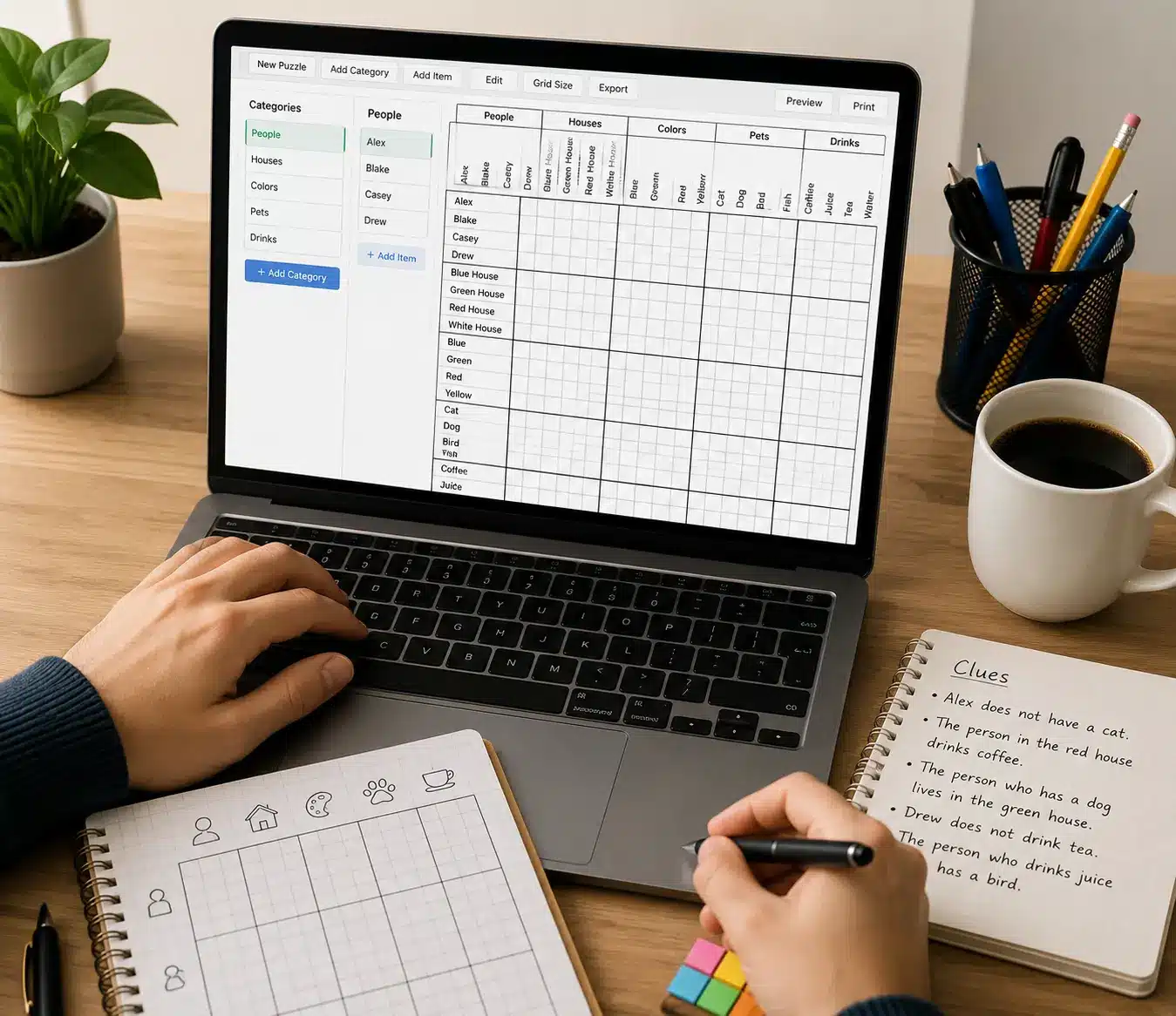
Logic grids are among the clearest examples of deduction-based puzzles. They usually contain several categories that must be matched correctly.
A puzzle may include four people, four pets, four favourite colours, and four houses. The clues might explain that one person does not own the cat, another person lives in the blue house, and the dog owner lives beside a particular neighbour.
Players mark confirmed matches and impossible combinations on a grid. As the number of possibilities decreases, the complete arrangement begins to appear.
People who are new to this style can begin with logic puzzles for beginners, which introduce the basic habits of reading clues carefully, marking possibilities, and solving one step at a time.
Logic grids are especially useful for players who enjoy organised problem-solving. The grid keeps information visible and prevents important deductions from being forgotten.
Sudoku
Sudoku is a number-placement puzzle based on logic. In the standard version, each row, column, and marked box must contain the required digits without repetition.
Although Sudoku uses numbers, it normally does not require advanced mathematics. Players do not need to add, subtract, or multiply the digits. They need to determine where each number can and cannot be placed.
Beginner puzzles may have many numbers already filled in, making the remaining choices fairly direct. Harder puzzles provide fewer starting numbers and require players to track several possible candidates.
Sudoku encourages patience because one correct placement may create opportunities elsewhere on the board. A number added in one box can help solve a row, which may then reveal another number in a different column.
Number Patterns
Number-pattern puzzles ask players to discover the relationship between values.
Consider this sequence:
4, 8, 16, 32, __
Each number is doubled, so the next value is 64.
Not every sequence is that direct. A pattern may alternate between two operations, increase by progressively larger amounts, use square numbers, or depend on the relationship between neighbouring values.
A fair number puzzle should have a clear rule that explains every term. If several unrelated answers appear equally reasonable, the puzzle may not contain enough information.
These puzzles can help players become more comfortable with comparison and mathematical relationships without requiring lengthy calculations.
Visual Patterns
Visual logic puzzles use shapes, symbols, colours, positions, or movements.
A triangle may rotate with each step. A square may gain one dot at a time. A symbol may move clockwise around a grid while changing colour on every second move.
The challenge is deciding which visual details matter. Some features follow the real rule, while others are included as distractions.
Visual puzzles encourage close observation. They remind players that two images can look similar while containing one small but important difference.
They can be particularly appealing to children and to players who prefer pictures over text-heavy clues.
Code Breakers
Code-breaking puzzles use symbols, numbers, letters, or previous guesses to reveal a hidden answer.
A player may need to decode a secret message, discover a password, or determine the correct order of several symbols. Each attempt provides new information about which parts are right, wrong, or placed incorrectly.
These puzzles often combine deduction with pattern recognition. Players must remember earlier results and compare them with later clues.
Code breakers feel like miniature mysteries. Rather than receiving the answer directly, the player uncovers it piece by piece.
Riddles
Logic riddles present a question or situation that requires careful interpretation.
Many riddles are difficult because people make an assumption that was never stated. The solution appears only when the player changes perspective or reads the wording more precisely.
Readers who enjoy this style can explore brain teaser logic puzzles, which combine riddles, patterns, deduction, and creative problem-solving.
A good riddle should feel fair after the answer is explained. The solution may be surprising, but it should still fit the wording and available information.
Riddles are particularly enjoyable in groups because different people often interpret the same situation in completely different ways.
Mazes
Mazes challenge players to find a route from one location to another.
Simple mazes mainly require visual tracking. More advanced versions may contain locked doors, keys, one-way paths, switches, limited moves, or areas that cannot be visited twice.
Instead of moving immediately, experienced players often examine the maze and identify possible dead ends first. Planning before acting can save time and reduce repeated mistakes.
Mazes are easy to understand, making them suitable for younger players. Their difficulty can also be increased enough to challenge adults.
Spatial Challenges
Spatial puzzles involve movement, rotation, folding, symmetry, and the relationship between shapes.
Tangrams ask players to arrange geometric pieces into a target image. Cube-net puzzles ask which flat design can be folded into a cube. Mirror puzzles require players to identify how an object would appear when reflected.
Jigsaw puzzles also involve several connected abilities, including visual perception, mental rotation, planning, and matching. Research has found that completing jigsaw puzzles draws on multiple cognitive processes, although evidence for broad long-term improvements remains limited.
Spatial puzzles are useful for people who enjoy working with images and physical objects. They provide a different experience from number grids and written clues while still requiring careful reasoning.
Benefits for Children
Brain train logic puzzles can help children practise important learning habits in an enjoyable format.
They encourage children to follow instructions, compare information, notice patterns, and explain how they reached an answer. A child solving a maze learns to plan ahead, while a sequence puzzle develops awareness of order and relationships.
Logic puzzles can also support reading comprehension. Children must pay attention to words such as before, after, beside, only, never, and exactly because each word affects the solution.
They can be used as classroom warm-ups, group challenges, homework activities, or quiet tasks for students who finish other work early.
The level should match the child’s experience. A puzzle that is too easy may feel boring, while one that is far too difficult may create frustration rather than useful practice.
Benefits for Adults
Adults often use logic puzzles for entertainment, relaxation, and mental stimulation.
Focusing on one manageable problem can provide a break from notifications, unfinished tasks, and everyday distractions. The player’s attention shifts toward the clues and possible solutions.
Puzzles also encourage persistence. A difficult challenge may require several attempts, a revised strategy, or the correction of an earlier mistake. Players learn that being temporarily stuck does not mean the puzzle is impossible.
Some studies have found associations between regular puzzle use and stronger performance on certain cognitive tests. However, associations do not prove that puzzles alone caused those differences.
The most realistic benefit is that players practise the specific skills required by the activity, including concentration, deduction, visual comparison, and structured problem-solving.
Focus and Memory

Many logic puzzles require players to hold several pieces of information in mind at once.
A Sudoku player may need to remember possible numbers while checking a row, column, and box. A code breaker may compare the latest clue with several previous attempts. A logic-grid solver must track confirmed facts and excluded combinations.
These activities exercise working memory during play. Research on formal cognitive training suggests that people often improve at the tasks they practise or at closely related tasks. Evidence for large improvements across unrelated abilities is less consistent.
For that reason, brain train puzzles should be viewed as enjoyable mental activities rather than guaranteed methods for increasing intelligence.
Problem-Solving Skills
Logic puzzles teach players to divide a large problem into smaller, more manageable steps.
A complicated grid may look overwhelming at first. The player does not need to solve it all at once. One clue may confirm one fact. That fact removes two possibilities, and those eliminations may reveal another answer.
This approach resembles practical problem-solving:
Understand the goal, identify known facts, remove impossible options, test a reasonable idea, and review the result.
Players also learn to separate assumptions from evidence. Something that seems likely is not necessarily proven.
That habit can be valuable whenever a person needs to organise information or make a careful decision.
Confidence and Patience
Completing a difficult puzzle creates a genuine sense of achievement because the result was reached through effort.
Players become more comfortable with uncertainty. They learn that confusion can be temporary and that progress may begin with one small observation.
This lesson can be particularly helpful for children who quickly believe they cannot solve something. A suitable puzzle shows that difficult tasks often become easier when they are divided into steps.
Hints can support this process, but they should not reveal the complete solution. A useful hint directs attention toward an overlooked clue and still allows the player to make the final deduction.
How to Solve Them
Start by reading the full puzzle before making any marks. A player who reacts to the first clue immediately may misunderstand the larger task.
Next, identify information that is directly confirmed. Keep proven facts separate from possible answers.
Look for restrictive clues. A clue leaving only one possible choice is usually more useful than one allowing several options.
Use a grid, list, sketch, or set of notes when the puzzle becomes complicated. Trying to remember everything mentally can create avoidable mistakes.
Combine clues whenever possible. One clue may not reveal much on its own, but two connected clues can produce a firm conclusion.
Finally, check the completed answer against every rule. A solution is only correct when all clues are satisfied.
When You Get Stuck
Getting stuck is a normal part of solving logic puzzles.
Begin by rereading the instructions. The difficulty may come from misunderstanding one rule rather than from the puzzle itself.
Review earlier answers and make sure they were proven. One incorrect assumption can produce several later contradictions.
Check for negative clues containing words such as not, cannot, never, or neither. These restrictions are easy to overlook but often provide the most useful eliminations.
Taking a short break can also help. Returning with fresh attention may make an unnoticed detail suddenly stand out.
Avoid uncontrolled guessing. A structured test can be useful when the result is checked carefully, but random choices usually make the puzzle more confusing.
Play Now
Try this quick logic puzzle:
Three boxes are labelled Apples, Oranges, and Mixed. Every label is incorrect. You may remove one piece of fruit from only one box. How can you label all three boxes correctly?
Choose a fruit from the box labelled Mixed.
Because every label is wrong, this box cannot contain mixed fruit. It must contain only apples or only oranges.
Suppose you remove an apple. The box labelled Mixed must therefore be the Apples box.
The box labelled Oranges cannot contain oranges because its label is wrong. It also cannot contain only apples because the Apples box has already been identified. Therefore, it must contain mixed fruit.
The remaining box, labelled Apples, must contain oranges.
The same reasoning works in reverse if an orange is removed first.
This puzzle shows how one carefully chosen action can reveal an entire solution.
Online and Printed Play
Online brain train logic puzzles often provide instant feedback, hints, difficulty settings, timers, daily challenges, and automatic progress tracking.
These features make it easy to begin playing without preparing materials. Players can also switch quickly between puzzle types and choose a level suited to their experience.
Printed puzzles offer a calmer, screen-free experience. They allow handwritten notes and work well in classrooms, waiting rooms, family activities, and quiet evening routines.
Physical puzzle sets, tangrams, cards, and wooden challenges add a hands-on element that digital games cannot completely reproduce.
Neither format is automatically better. The best choice depends on the player’s age, situation, and personal preference.
How Often to Play
There is no perfect schedule for brain train logic puzzles.
A short session of ten to twenty minutes can provide an enjoyable challenge without becoming tiring. Some people prefer one puzzle each morning, while others play during breaks or at weekends.
Regular practice can make familiar strategies easier to recognise, but the activity should remain enjoyable. Stop when frustration replaces curiosity.
Changing puzzle types can also keep the experience fresh. A player might attempt Sudoku one day, a riddle the next, and a visual challenge later in the week.
Gradually increasing difficulty is usually better than moving directly from beginner puzzles to expert-level problems.
Realistic Expectations
Brain train logic puzzles are mentally engaging, but their benefits should not be exaggerated.
There is not strong evidence that ordinary puzzle games can guarantee higher intelligence, prevent dementia, or improve every mental ability. Organisations such as Alzheimer’s Society explain that evidence for brain-training activities reducing dementia risk remains limited.
Harvard Health has similarly noted that becoming better at a particular brain game does not necessarily produce large improvements in unrelated everyday abilities.
That does not make puzzles unimportant. They still offer entertainment, focused practice, social interaction, and a satisfying reason to think carefully.
Broader brain health depends on many factors, including physical activity, sleep, social connection, balanced nutrition, continuing learning, and appropriate medical care.
Final Thoughts
Brain train logic puzzles make thinking more fun by turning reasoning into an achievable and rewarding challenge.
They ask players to slow down, examine clues, remove impossible choices, and build a solution one step at a time. Children can use them to practise instructions and pattern recognition, while adults may enjoy them as a calm break from everyday distractions.
Their value does not depend on dramatic promises. A puzzle does not need to transform intelligence to be worthwhile.
The pleasure of finding a hidden rule, completing a difficult grid, solving a clever riddle, or making the final correct deduction is often reason enough to play.
FAQs
What are brain train logic puzzles?
They are puzzles that use clues, patterns, deduction, and observation to reach a logical solution.
Are brain train logic puzzles suitable for children?
Yes. Children can begin with simple mazes, matching activities, visual patterns, and small logic grids.
Do logic puzzles improve intelligence?
They help people practise specific thinking skills, but they do not guarantee broad increases in intelligence.
How often should I solve logic puzzles?
A short session several times a week is enough for enjoyable and consistent practice.
Where can I play brain train logic puzzles?
They are available through online games, mobile apps, puzzle books, printable worksheets, and physical puzzle sets.