
Logic puzzles are more than simple brain games. They are small challenges that ask you to think clearly, read carefully, and use clues in the right order. Whether you are solving a number puzzle, grid puzzle, matchstick puzzle, triangle puzzle, or riddle, the main goal is the same: use logic instead of guessing.
Many people enjoy logic puzzles because they feel simple at first, but they slowly make the brain work harder. A good puzzle can test your patience, focus, memory, and problem-solving skills. That is why logic puzzle tips are useful for beginners, students, teachers, parents, and puzzle lovers.
The good thing is that solving logic puzzles is not only about being naturally smart. Most puzzles become easier when you follow a clear method. With the right approach, you can understand clues faster, avoid common mistakes, and solve puzzles more confidently.
Quick Facts About Logic Puzzle Tips
| Box | Details |
|---|---|
| Article Title | Logic Puzzle Tips: Simple Ways to Solve Puzzles Smarter |
| Topic Type | Puzzle guide |
| Main Audience | Beginners, students, teachers, adults, and puzzle lovers |
| Purpose | To help readers solve puzzles with better thinking |
| Skill Level | Beginner friendly |
| Main Focus | Clue reading, pattern finding, and step-by-step solving |
| Best For | Brain training, classroom learning, and casual puzzle practice |
| Puzzle Types Covered | Grid, number, pattern, triangle, riddle, and matchstick puzzles |
| Key Benefit | Improves problem-solving and focus |
| Learning Style | Simple, clear, and practical |
| Recommended Method | Read carefully, eliminate wrong answers, and check all clues |
| Article Tone | Informative, calm, and human-friendly |
| User Action | Play and practice logic puzzles regularly |
What Are Logic Puzzle Tips?
Logic puzzle tips are simple strategies that help you solve puzzles in a smarter way. These tips teach you how to read clues, organize information, remove wrong options, and check your answer step by step. Beginners who are still learning the basics can also explore logic puzzles for beginners to build confidence with easier challenges first.
A logic puzzle usually gives you limited information. You need to connect the clues and find the correct result. Sometimes the answer is hidden in a pattern. Sometimes it comes from eliminating wrong choices. Sometimes one small word changes the full meaning of the puzzle.
For example, a clue like “Ali is not sitting next to Sara” does not tell you where Ali is sitting. But it does remove some possible positions. This is how logic puzzles work. Every clue may not give the answer directly, but every clue reduces confusion.
Good logic puzzle tips help you stop rushing. They make your thinking more organized and careful.
Why Logic Puzzles Matter
Logic puzzles are useful because they train the brain to think in a structured way. They encourage problem-solving, attention to detail, and decision-making.
A puzzle is not only about finding an answer. It is also about understanding how the answer appears. This process teaches the brain to slow down, compare information, and follow a clear path.
In classrooms, logic puzzles can also make learning feel more active. Students do not only listen or memorize. They test ideas, discuss clues, and learn from small mistakes.
This is why logic puzzles are not only for entertainment. They can support learning, focus, patience, and better thinking habits.
Start With the Goal
Before solving any puzzle, first understand what the puzzle wants from you. This sounds simple, but many mistakes happen because people start solving before they understand the question.
Ask yourself: Am I finding a missing number? Am I counting shapes? Am I matching names with objects? Am I moving matchsticks? Am I finding the correct order?
When the goal is clear, your mind knows what to look for. A triangle logic puzzle may need you to find a missing number. A grid puzzle may need you to match people with pets, colors, or places. A pattern puzzle may ask you to find the next shape or symbol.
Never skip this first step. A clear goal makes the whole puzzle easier.
Read Every Clue Slowly
One of the best logic puzzle tips is to read every clue slowly. Logic puzzles often hide important meaning in small words.
Words like not, only, before, after, between, next to, same, and different are very important. If you miss one of these words, your answer can become wrong.
For example, “Sara is not second” does not mean Sara is first or last. It only means she cannot be in the second position. A careful solver uses that clue correctly and waits for more information.
Read the puzzle once to understand it. Then read it again to find the useful clues. If the puzzle is difficult, read each clue one by one and write down what it tells you.
Use a Table or Diagram
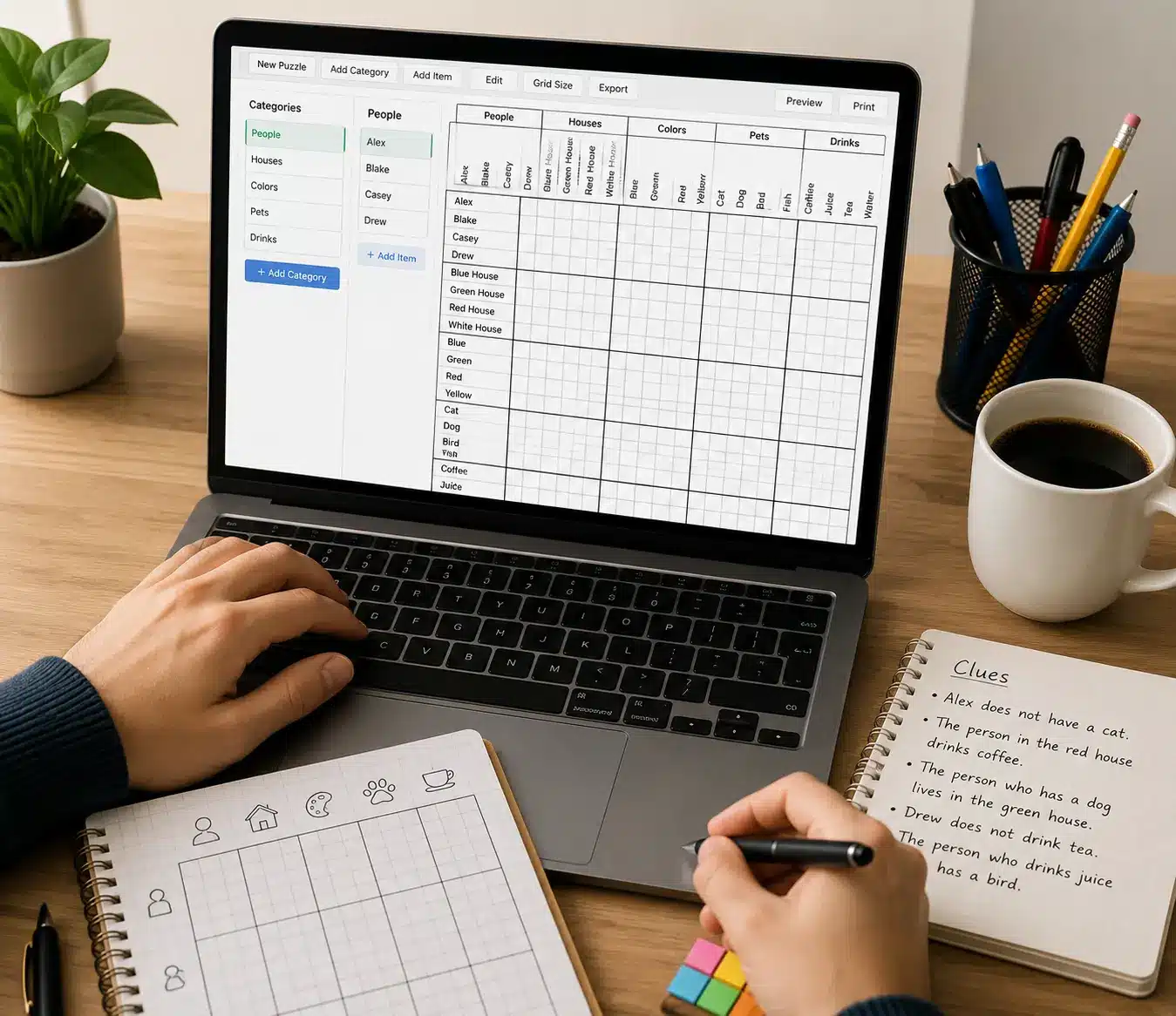
Many logic puzzles become easier when you stop solving everything in your head. A table, grid, or small diagram can make the information much clearer.
For a grid logic puzzle, you can draw rows and columns. Use a check mark for something correct and an X for something impossible. This helps you see what options are still open.
For a triangle puzzle, draw the triangle again on paper. Write the numbers clearly. Look at the sides, corners, and center carefully.
For matchstick puzzles, draw the sticks and mark which ones can move. Do not try to remember every move mentally.
A visual method reduces mistakes. It also helps you see connections that are easy to miss when you only think in your head.
Find the Strongest Clue
Not all clues are equal. Some clues are direct and powerful. Others only become useful later.
A strong clue gives clear information. For example, “John owns the blue bag” is a strong clue. You can mark it immediately.
A weaker clue may say, “The person with the blue bag is not sitting beside Ali.” This clue is useful, but it needs other clues before it becomes fully helpful.
A smart way to solve logic puzzles is to begin with the strongest clue. Add the direct information first. Then use the remaining clues to remove wrong options.
This method keeps your solving process clean and simple.
Remove Wrong Answers
Logic puzzles are not only about finding the correct answer. They are also about removing the wrong answers.
This is called elimination. It is one of the most useful logic puzzle tips for beginners.
If a clue says someone does not have a red car, mark that option as wrong. If a number cannot fit a pattern, remove it from your possible answers. If a shape cannot be counted twice, cross it out.
Every wrong option you remove takes you closer to the correct answer. Sometimes you may not know the answer directly, but after removing all impossible choices, only one option remains.
That remaining option is often the solution.
Look for Patterns
Many logic puzzles are based on patterns. These patterns can appear in numbers, shapes, colors, positions, or words.
In number puzzles, check whether numbers are being added, subtracted, multiplied, divided, squared, or arranged in a sequence. In shape puzzles, look at rotation, size, direction, number of sides, or repeated symbols.
For example, if numbers are increasing by 2, 4, 6, and 8, the next increase may be 10. If a shape rotates clockwise each time, the next shape should follow the same movement.
Pattern recognition is a major part of logic puzzle solving. The more puzzles you practice, the easier it becomes to spot these hidden rules.
Avoid Guessing Too Early
Guessing can feel tempting, especially when a puzzle looks hard. But guessing too early can create confusion.
If your guess is wrong, every step after that may also become wrong. This is why it is better to use clues first. Guess only when you have very few options left, and even then, test the guess carefully.
A better method is to say, “If this is true, what happens next?” Then check whether the result matches every clue. If one clue breaks the guess, remove it and try another option. This calm method is also useful when solving logic puzzles that require step-by-step reasoning instead of quick guessing.
This way, even guessing becomes controlled and logical.
Check Negative Clues
Negative clues are easy to ignore, but they are very powerful. A negative clue tells you what is not true.
For example:
Ali does not like mango.
The red house is not beside the green house.
The number is not even.
These clues do not give the full answer, but they remove important possibilities.
Beginners often focus only on positive clues because they feel easier. But in many puzzles, the answer is found by using negative clues carefully.
Whenever you see not, never, cannot, or isn’t, slow down and mark that clue properly.
Break Big Puzzles Into Small Parts

Some logic puzzles look difficult because they include too much information at once. The best way to solve them is to break them into small parts.
Do not try to solve the full puzzle immediately. Start with one clue. Then connect it with another clue. Then remove one wrong option. Small steps create progress.
This method is especially helpful for students and beginners. A big puzzle becomes less scary when you treat it like a series of small decisions.
Good solvers do not rush to the end. They build the answer slowly.
Use Common Sense Carefully
Common sense can help, but it can also mislead you. Logic puzzles only follow the information given in the puzzle.
Do not assume extra details unless the puzzle clearly says them.
For example, if a clue says “Ahmed arrived before Bilal,” it does not mean Ahmed arrived first. It only means he arrived earlier than Bilal. Someone else may have arrived before both of them.
This is one of the most common mistakes in logic puzzles. People add information that is not actually written.
Always stay close to the clues.
Play Now
The best way to improve is to practice. Reading logic puzzle tips is helpful, but solving real puzzles is where your skill grows.
You can start with easy puzzles first. Try simple missing number puzzles, basic grid puzzles, small pattern puzzles, and short riddles. Once you feel comfortable, move to harder puzzles with more clues.
When you play now, do not focus only on speed. Focus on accuracy. A slow correct answer is better than a fast wrong answer.
You can also challenge yourself by solving one puzzle daily. Over time, your brain becomes better at finding patterns, reading clues, and avoiding careless mistakes.
Benefits of Logic Puzzle Tips
Logic puzzle tips help improve problem-solving skills. When you solve puzzles, you learn how to understand a problem, test possible answers, and remove mistakes, it increase your cognitive abilities.
They also improve focus. Many puzzles require careful attention because one small clue can change the answer. This makes puzzles useful for students who want to build concentration.
Logic puzzles can support critical thinking too. Critical thinking means looking at information carefully and making a reasoned decision.
Another benefit is patience. Some puzzles cannot be solved in one minute. They require calm thinking. This helps people learn not to give up too quickly.
Logic puzzle tips also make learning more enjoyable. Teachers can use puzzles in the classroom. Parents can use them at home. Puzzle lovers can use them as a fun brain exercise.
For Students
Students can benefit a lot from logic puzzle tips. These puzzles help with math logic puzzle reasoning, reading comprehension, science thinking, and exam preparation.
A student who practices logic puzzles learns how to read instructions carefully. This skill is useful in school tests because many wrong answers happen when students misunderstand the question.
Logic puzzles also teach students how to work step by step. Instead of guessing, they learn to use evidence from the clues.
For younger students, puzzles should be simple and colorful. For older students, puzzles can include harder clues, number patterns, and multi-step reasoning.
For Adults
Logic puzzles are also useful for adults. They offer a simple way to keep the mind active and focused.
Adults can solve puzzles during breaks, while traveling, or as a relaxing evening activity. Many people enjoy Sudoku, crosswords, riddles, grid puzzles, and brain teasers because they give the mind something enjoyable to work on.
For adults, logic puzzle tips can also help in real-life thinking. Planning, comparing options, solving work problems, and making decisions all use similar thinking skills.
Common Mistakes
One common mistake is rushing through the clues. Logic puzzles reward careful reading, not speed.
Another mistake is guessing too early. A guess may look correct at first but fail when checked against another clue.
A third mistake is ignoring negative clues. These clues often hold the key to removing wrong answers.
Some people also forget to check the final answer. Always go back and compare your answer with every clue. If all clues fit, your answer is likely correct.
Final Thoughts
Logic puzzle tips help you solve puzzles in a clear, calm, and smarter way. They teach you how to read clues, use tables, remove wrong options, find patterns, and check your answer.
The most important thing is practice. You do not need to be perfect from the beginning. Start with easy puzzles, learn from mistakes, and slowly try harder challenges.
Logic puzzles are fun, but they are also useful. They build focus, patience, memory, and problem-solving skills. Whether you are a student, teacher, parent, adult, or puzzle lover, the right tips can make every puzzle easier to understand.
If you want to solve puzzles smarter, begin with one simple rule: read carefully, think step by step, and never guess before using the clues.
FAQs
What are logic puzzle tips?
Logic puzzle tips are simple methods that help you read clues, remove wrong options, and solve puzzles step by step.
Are logic puzzles good for beginners?
Yes, logic puzzles are great for beginners because they build focus, patience, and clear thinking slowly.
How can I solve logic puzzles faster?
Start with direct clues, use a table or diagram, remove impossible answers, and check every clue again.
Why should students practice logic puzzles?
Students can improve reading, reasoning, problem-solving, attention to detail, and confidence through regular puzzle practice.
What is the biggest mistake in logic puzzles?
The biggest mistake is guessing too early without carefully using all the clues.
Related Puzzle Resources
For more solving help and puzzle creation ideas, try these related guides: