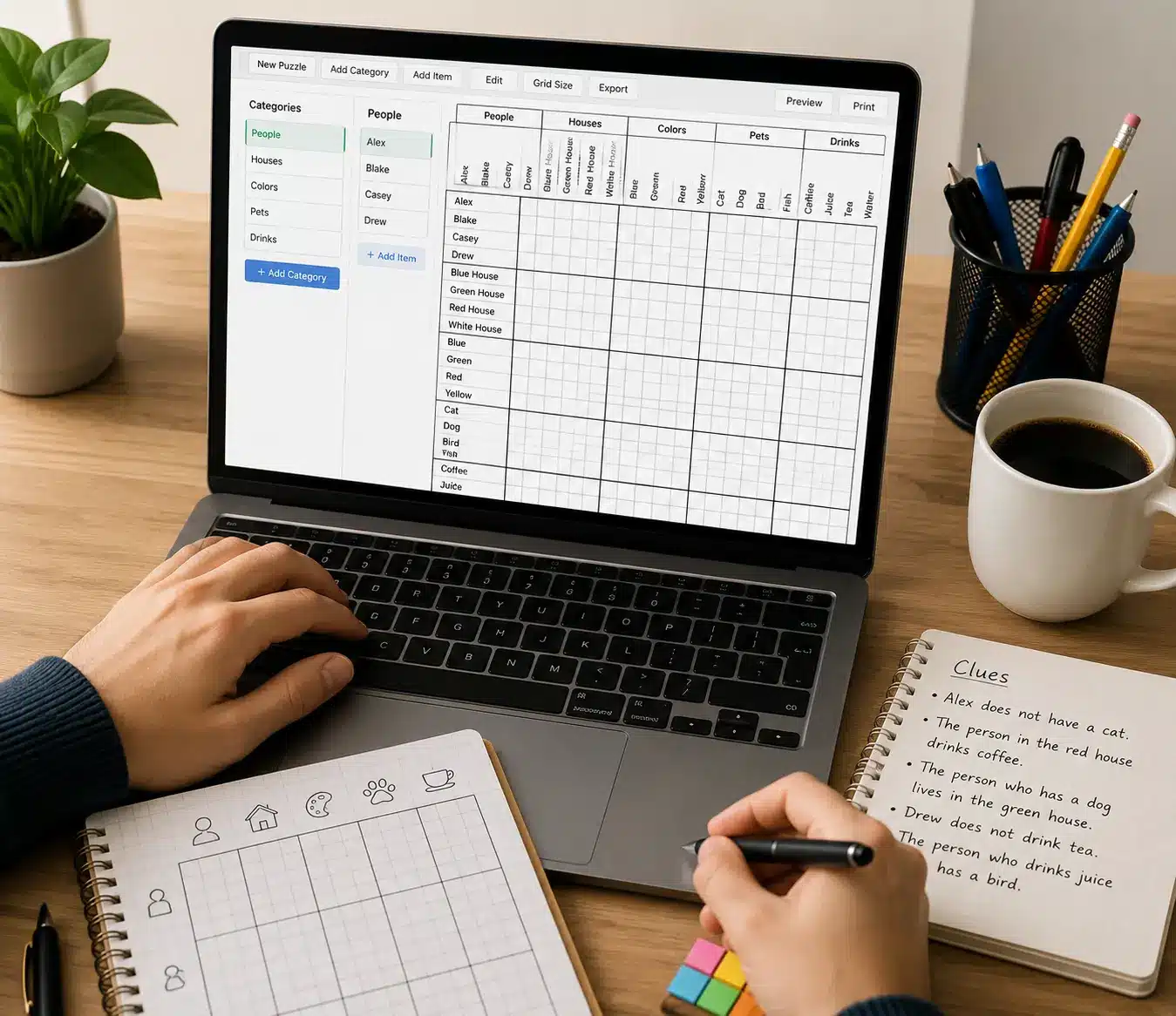

A logic puzzle creator is a helpful tool for making puzzles that test reasoning, focus, memory, and problem-solving skills. These puzzles are not only for fun. They can also be used in classrooms, brain-training websites, printable worksheets, online games, and learning activities.
A good logic puzzle makes the player think step by step. It gives clues, hides the answer, and asks the player to use logic instead of guessing. That is what makes logic puzzles interesting. They feel simple at first, but the more you solve them, the more your brain starts connecting clues, removing wrong choices, and finding the correct answer.
Logic puzzles are connected with deduction, which means reaching an answer by using given facts carefully. A logic puzzle is commonly described as a puzzle based on deductive reasoning, where the solver uses clues or premises to reach a conclusion.
Quick answer: A logic puzzle creator helps writers design fair, solvable puzzles by choosing categories, building clues, and checking that only one answer fits. Good puzzle creation starts with the solution, then works backward through clear clues.
Quick Facts
| Box | Details |
|---|---|
| Topic Type | Puzzle guide |
| Main Purpose | Explain how logic puzzle creators work |
| Best Audience | Students, teachers, puzzle lovers, and website owners |
| Content Style | Informative, simple, and beginner-friendly |
| Main Benefit | Helps readers understand puzzle creation |
| Puzzle Type Covered | Logic, grid, deduction, number, and word puzzles |
| Website Use | Brain games, puzzle blogs, and educational content |
| Learning Value | Improves reasoning and problem-solving |
| Special Section | Play Now |
| Focus | Discover-friendly and natural keyword use |
What Is a Logic Puzzle Creator?
A logic puzzle creator is a tool, app, website feature, or manual system that helps people create logic-based puzzles. Instead of writing every clue, answer, grid, and rule from scratch, a creator gives structure to the puzzle-making process.
It can help you create different types of puzzles, such as logic grid puzzles, number puzzles, matching puzzles, deduction puzzles, word puzzles, classroom brain teasers, and online puzzle games.
For example, a logic puzzle creator may allow you to add three categories: people, pets, and cities. Then you add clues like “Ali does not own the cat” or “The person from Lahore has a dog.” After that, the puzzle creator helps organize the grid and answer key.
The main goal is simple: make puzzle creation easier, cleaner, and more enjoyable.
Why Logic Puzzles Are Popular
Logic puzzles are popular because they give people a small challenge that feels rewarding. A player does not need special equipment or advanced knowledge. They only need attention, patience, and the ability to think clearly.
This is why logic puzzles work well for students, adults, teachers, parents, bloggers, and game lovers. They can be short or long, easy or difficult, printable or interactive.
A well-made puzzle gives the solver a feeling of progress. Every clue removes one wrong option. Every correct step brings the player closer to the final answer. That small mental reward keeps people engaged.
How a Logic Puzzle Creator Works
A logic puzzle creator usually follows a simple process.
First, you choose the type of puzzle you want to make. It may be a grid puzzle, matching puzzle, number puzzle, or deduction puzzle.
Next, you add the puzzle elements. These can include names, objects, places, colors, numbers, events, animals, jobs, or any other category.
Then, you write clues. Clues are the heart of a logic puzzle. They guide the player without giving the answer too quickly.
After that, the creator organizes everything into a readable format. Some tools may generate a grid, answer key, hint system, or printable worksheet.
Finally, the puzzle is tested. This step is very important because a logic puzzle should have one clear answer. If the puzzle has many possible answers, the player may feel confused or cheated.
Main Parts of a Good Logic Puzzle
A strong logic puzzle has a few important parts.
The first part is the theme. A puzzle can be about students, animals, sports, food, cities, books, or anything else. A simple theme makes the puzzle easier to understand.
The second part is the categories. In a grid puzzle, categories may include names, ages, pets, hobbies, or locations.
The third part is the clues. Good clues should be clear, fair, and useful. They should help the solver move forward.
The fourth part is the answer key. Every puzzle should have a confirmed solution.
The fifth part is the difficulty level. Beginners need simple puzzles. Advanced players enjoy deeper clues and more categories.
When these parts are balanced, the puzzle feels smooth and satisfying.
Benefits of Using a Logic Puzzle Creator
A logic puzzle creator saves time. Making puzzles manually can take longer than expected because every clue must work correctly. A creator helps organize the work and makes the process faster.
It also improves puzzle quality. When clues are placed carefully, the puzzle becomes easier to follow and more fun to solve.
Another benefit is consistency. If you run a puzzle website or blog, you may need fresh puzzles often. A logic puzzle creator can help you build regular content without starting from zero every time.
For teachers, it can be very useful. Logic puzzles encourage step-by-step thinking, elimination, and reasoning. These skills are helpful in classrooms because students learn how to read carefully, compare details, and make better decisions.
For website owners, logic puzzles can increase engagement. People spend more time on interactive content because they are actively solving something, not just reading.
Logic Puzzle Creator for Students
Students can benefit a lot from logic puzzles, especially when they start with logic puzzles for beginners that train the mind to read carefully, compare details, and make decisions based on evidence.
In school, students often need to solve problems in math, science, reading, and real-life situations. Logic puzzles support these skills because they teach learners to slow down and think.
For example, a student may read a clue and decide that one answer is not possible. Then they check another clue and remove another wrong option. This process teaches patience and careful thinking.
Logic puzzles also help students understand that answers should come from evidence, not guessing. That is a useful habit for learning and everyday problem-solving.
Logic Puzzle Creator for Teachers
Teachers can use a logic puzzle creator to make classroom activities more interesting. Instead of giving only worksheets with direct questions, teachers can create puzzles that make students think.
A teacher can make puzzles for math, reading comprehension, science vocabulary, history facts, or general reasoning.
For younger students, puzzles can be simple. For older students, the clues can be more detailed. Teachers can also use puzzles for group work, warm-up activities, homework, or revision.
Logic puzzles are useful because they do not feel like boring exercises. Students often see them as games, but they are still learning.
Logic Puzzle Creator for Websites
If you own a puzzle website, education blog, or brain game platform, a logic puzzle creator can be very helpful.
You can use it to publish daily puzzles, weekly challenges, printable worksheets, interactive games, or puzzle-based blog posts.
A Play Now section can also improve your article. Instead of only explaining the puzzle, you can invite readers to try a simple puzzle directly on the page.
For example:
Play Now:
Three friends — Ali, Sara, and Hamza — each have a different fruit: apple, banana, and mango.
Clues:
Ali does not have the banana.
Sara does not have the apple.
Hamza has the mango.
Question:
Who has the apple?
This kind of simple puzzle keeps readers active. It also makes the article more useful and enjoyable.
Play Now
Here is a small logic puzzle you can add inside your article.
Puzzle:
Three students — Ayan, Bilal, and Zoya — joined three different clubs: Art, Science, and Sports.
Clues:
Ayan did not join Sports.
Bilal did not join Art.
Zoya joined Science.
Question:
Which club did each student join?
Answer:
Zoya joined Science.
Bilal joined Sports.
Ayan joined Art.
This is a simple example, but it shows how logic works. The player reads the clues, removes wrong options, and reaches the answer.
Types of Logic Puzzles You Can Create
There are many types of puzzles you can create with a logic puzzle creator.
A logic grid puzzle uses rows and columns. Players mark yes or no options until they find the correct match of logical puzzles.
A number logic puzzle uses numbers, sequences, patterns, or calculations.
A word logic puzzle uses words, clues, meanings, or letters.
A deduction puzzle gives facts and asks the player to find what must be true.
A visual logic puzzle uses shapes, symbols, colors, or images.
A matching puzzle asks the player to connect people, items, places, or actions.
Each type has its own style, but the main idea stays the same: use clues to find the answer.
Features of a Good Logic Puzzle Creator

A good logic puzzle creator should be easy to use. Beginners should not feel lost when creating their first puzzle.
It should allow users to add categories, clues, answers, difficulty levels, and instructions.
It should also include a solution checker. This is important because a logic puzzle must be fair. If the puzzle has no clear solution, people will lose interest.
A printable option is also useful, especially for teachers and parents.
For websites, mobile-friendly design is important. Many users play games and read articles on phones, so the puzzle should look clean on small screens.
A good creator may also include hints, timer options, reset buttons, score tracking, and answer reveal features.
How to Create a Better Logic Puzzle
Start with a simple idea. Do not begin with too many categories. A puzzle with three names and three items is enough for beginners.
Choose a clear theme. For example, pets, fruits, cities, school subjects, or hobbies.
Write the final answer first. This helps you create clues that lead toward the correct solution.
Then write clues one by one. Make sure each clue helps the solver make progress.
Avoid clues that are too vague. A clue should not confuse the reader.
After writing the puzzle, solve it yourself. If you cannot solve it clearly, the player may also struggle, so it helps to understand the basics of solving logic puzzles before publishing.
Then ask someone else to test it. Fresh eyes can catch mistakes you may miss.
Common Mistakes to Avoid
One common mistake is creating a puzzle with more than one answer. This makes the puzzle unfair.
Another mistake is using unclear clues. If the player cannot understand what a clue means, the puzzle becomes frustrating.
Some creators also make puzzles too hard too quickly. A beginner puzzle should feel welcoming.
Another mistake is not adding an answer key. Players want to check their solution after solving.
Poor formatting is also a problem. If the puzzle is hard to read, many users will leave before trying it.
A good puzzle should be clean, fair, and easy to follow.
Why Logic Puzzle Creator Helps Brain Training
Logic puzzles can help train the brain because they require attention and reasoning. Players must compare clues, remember details, and test possible answers.
This process supports critical thinking. Critical thinking skills means thinking clearly, judging information, and reaching a conclusion after looking at the facts.
Logic puzzles are also good for focus. The player must stay with the clues until the answer becomes clear.
They can also support memory because the solver needs to remember relationships between items.
Most importantly, logic puzzles teach people not to guess too quickly. They encourage careful thinking.
Best Uses of a Logic Puzzle Creator
A logic puzzle creator can be used in many ways.
Teachers can create classroom tasks. Parents can make learning games for children. Bloggers can add puzzle examples inside articles. Website owners can publish daily puzzle challenges. Game developers can design puzzle levels. Students can practice reasoning skills.
It can also be useful for printable worksheets, social media puzzle posts, newsletters, and quiz pages.
The best thing about a logic puzzle creator is flexibility. You can make a small puzzle for kids or a detailed puzzle for serious puzzle fans.
Simple Example of a Logic Puzzle Format
Here is a clean format you can use:
Title: Fruit Match Puzzle
Players: Ali, Sara, Hamza
Items: Apple, Banana, Mango
Clues:
Ali does not have the mango.
Sara has the banana.
Hamza does not have the apple.
Question:
Who has each fruit?
Answer:
Sara has the banana.
Hamza has the mango.
Ali has the apple.
This format is simple, readable, and useful for beginners.
Final Thoughts
A logic puzzle creator is more than just a puzzle-making tool. It is a smart way to build activities that improve reasoning, focus, and problem-solving.
It helps teachers create learning tasks, helps website owners publish engaging content, and helps puzzle lovers design better brain games.
A good logic puzzle should be clear, fair, and enjoyable. It should guide the player with useful clues and lead to one correct answer.
If you want to make better brain puzzles, start small. Choose a simple theme, write clear clues, test your answer, and make sure the puzzle feels fun to solve.
That is the real value of a logic puzzle creator. It turns simple ideas into smart puzzles that people can read, play, and enjoy.
FAQ
What is a logic puzzle creator?
A logic puzzle creator is a tool or method used to design puzzles based on clues, reasoning, and deduction.
Who can use a logic puzzle creator?
Teachers, students, bloggers, puzzle website owners, parents, and game developers can use it.
What type of puzzles can it create?
It can create logic grid puzzles, matching puzzles, number puzzles, word puzzles, and deduction-based brain games.
Why are logic puzzles good for the brain?
They help improve focus, memory, problem-solving, critical thinking, and careful reading.
Can I use a logic puzzle creator for my website?
Yes, it is useful for puzzle websites, classroom pages, printable worksheets, and “Play Now” interactive sections.
Related Puzzle Resources
For more puzzle ideas and reasoning practice, try these related guides: