Gifted students often understand new ideas quickly, notice connections that others overlook and complete ordinary classroom tasks with little difficulty. Although these abilities can be helpful, they can also make routine learning feel repetitive. Advanced learners need activities that introduce uncertainty, demand sustained concentration and encourage them to explore more than one possible strategy.
Logic puzzles for gifted students provide that kind of challenge. Rather than testing how many facts a learner can remember, they ask students to examine clues, identify patterns, eliminate impossible choices and explain why a conclusion is correct.
A good puzzle may look simple on the page. It might contain a small grid, a few shapes, a short sequence or several sentences describing different conditions. The difficulty comes from understanding how all the pieces fit together.
These activities can be used in classrooms, gifted education programs, homeschooling routines or family game sessions. They are enjoyable, but they also develop thinking habits that support learning across mathematics, science, reading, coding and everyday problem-solving.
Quick Bio Table
| Feature | Details |
|---|---|
| Main topic | Logic puzzles designed for gifted and advanced learners |
| Primary purpose | Developing reasoning through structured challenges |
| Suitable learners | Gifted students, advanced learners and curious problem-solvers |
| Typical age range | Elementary, middle school and secondary students |
| Main skills | Critical thinking, deduction and pattern recognition |
| Other benefits | Focus, patience, confidence and persistence |
| Popular formats | Grids, sequences, Sudoku, mysteries and visual puzzles |
| Difficulty levels | Beginner, intermediate, advanced and expert |
| Common setting | Classroom, home, enrichment club or online learning |
| Average playing time | Around 5 to 45 minutes, depending on difficulty |
| Materials needed | Paper, pencil, puzzle cards or a digital device |
| Best approach | Solve carefully, record deductions and explain the answer |
What They Are
Logic puzzles are structured problems solved through reasoning rather than memorization. The player receives clues, rules, symbols, patterns or conditions and must use that information to reach a valid conclusion.
Some puzzles have one definite answer. Others may allow several solutions, provided that every solution follows the stated conditions.
A traditional logic-grid puzzle might introduce four students, four school projects and four presentation times. The solver must use written clues to determine which student completed each project and when it was presented.
Other puzzles may ask students to continue a pattern, identify a hidden rule, arrange objects in the correct order, decode a message or find a route through a maze.
The answer should not depend entirely on luck. Guessing can sometimes be used to test a possibility, but the final solution must be supported by evidence.
Why They Matter
Gifted learners do not simply need more work. Giving an advanced student twice as many routine questions may increase the workload without increasing the depth of learning.
A stronger approach is to offer activities that involve complexity, novelty and choice.
The National Association for Gifted Children emphasizes the importance of appropriately challenging learning experiences for advanced students. These experiences may include critical thinking, creative thinking, problem-solving and inquiry.
Logic puzzles support these goals because students are not always told which method to use. They must decide where to begin, which clue matters most and how to change their approach if the first attempt fails.
Older learners who enjoy age-appropriate challenges can also explore logic puzzles for teens, where multi-step clues and structured challenges encourage careful reasoning without relying on repetitive classroom exercises.
Meaningful Difficulty
Gifted students sometimes become used to finding answers quickly. When a genuinely difficult problem appears, they may feel frustrated because the solution is not immediately clear.
Logic puzzles introduce a healthier kind of difficulty.
A student may need to make several attempts, erase an incorrect deduction or return to a clue that was misunderstood. This teaches an important lesson: struggling with a problem does not mean that the learner lacks ability.
It often means that a different strategy is needed.
The challenge should still be fair. Confusing instructions, missing information and random trick answers do not create meaningful difficulty. A strong puzzle gives students enough evidence to make progress, even when the path is not obvious.
Critical Thinking
One of the clearest benefits of logic puzzles is the development of critical thinking.
Critical thinking requires students to distinguish between facts, possibilities and assumptions. They must examine what a clue actually proves instead of adding information that was never stated.
Suppose a clue says:
“Hamza completed his project before the student wearing blue.”
This tells us that Hamza was earlier than one particular student. It does not prove that Hamza finished first or that he was not wearing another color.
A careful solver records only what the clue establishes.
This habit becomes useful when students interpret data, compare sources, evaluate arguments or decide whether a conclusion is supported by evidence.
Deductive Reasoning
Deduction means using known facts to reach a necessary conclusion.
In a puzzle, a student may reason:
If Sara cannot be first or third, she must be second or fourth.
Later, another clue may eliminate fourth place. Sara must then be second.
Each conclusion creates new information that can be combined with other clues. A complex puzzle may require dozens of these small deductions before the final answer becomes clear.
Students learn that an answer should not merely seem correct. It should follow logically from the information provided.
Problem-Solving
Logic puzzles show students how to approach unfamiliar problems systematically.
A useful process includes:
- Understanding the goal
- Identifying the known facts
- Recording direct clues
- Eliminating impossible options
- Testing remaining possibilities
- Checking the final answer
This process can be used far beyond puzzles.
When students face a difficult mathematics question, science investigation or coding error, they can break it into smaller parts instead of treating it as one overwhelming problem.
A failed attempt is also useful. It can reveal which assumption was incorrect or which rule was overlooked.
Pattern Recognition
Patterns may appear in numbers, letters, shapes, movements, positions or repeated relationships.
Consider this sequence:
3, 6, 9, 12, ?
The rule is straightforward: add three each time.
Now consider:
2, 5, 4, 7, 6, 9, ?
This sequence contains two connected patterns. The numbers in the odd positions are 2, 4, 6 and 8, while the even positions are 5, 7 and 9.
Gifted-level pattern puzzles often involve more than one changing feature. A shape may rotate while changing size, color or number of sides.
Students who enjoy hidden rules and structured relationships may also explore IQ test logic puzzles, which focus on recognizing patterns and applying a rule consistently.
Pattern recognition supports algebra, coding, music, language learning and scientific classification.
Flexible Thinking
Not every puzzle can be solved using the same method.
A student may begin with a list and discover that a grid would be clearer. Another may solve a sequence from the beginning, while a classmate works backward from the expected result.
This ability to change methods is known as flexible thinking.
It matters because real problems rarely appear in a familiar worksheet format. Students must recognize when a strategy is no longer useful and try a different approach.
A good puzzle may have one correct answer but several valid solution methods. Comparing those methods helps students understand that efficiency, clarity and creativity are important parts of problem-solving.
Concentration
Multi-step puzzles demand close attention.
A single word such as before, after, beside, only or not can change the entire solution. Students must read carefully and remember how one condition affects another.
This encourages learners to slow down rather than rush toward the first answer that looks possible.
Regular puzzle practice can also help students remain focused on one task for longer periods. The activity has a clear goal, but reaching it requires patience and careful checking.
Working Memory
Working memory allows students to hold and use information for a short period.
During a puzzle, a learner may need to remember that the blue object cannot be a triangle, the triangle appears before the circle and the circle cannot be in the final position.
As puzzles grow more complex, students learn not to keep everything in their heads. They begin using grids, symbols, diagrams and written notes.
This is an important learning habit. Strong problem-solvers organize information externally so that their attention can be used for reasoning rather than remembering every small detail.
Persistence
Gifted learners may not always receive enough opportunities to practice persistence.
If most schoolwork feels easy, they may rarely experience the stage between understanding a problem and finding its solution.
Logic puzzles make that stage unavoidable.
A learner might spend several minutes without making obvious progress. One deduction may eventually unlock the rest of the puzzle.
This experience teaches students that progress is not always immediate. Careful effort, revision and patience can matter more than speed.
Confidence
Completing a challenging puzzle can build genuine confidence.
This confidence does not come from being told that the student is naturally clever. It comes from seeing that concentration, strategy and persistence produced a result.
The learner begins to believe:
“I can handle unfamiliar problems, even when I do not know the answer immediately.”
Confidence also grows when students explain their reasoning. Describing the solution helps them recognize what they did successfully and which strategies they can use again.
Logic Grids
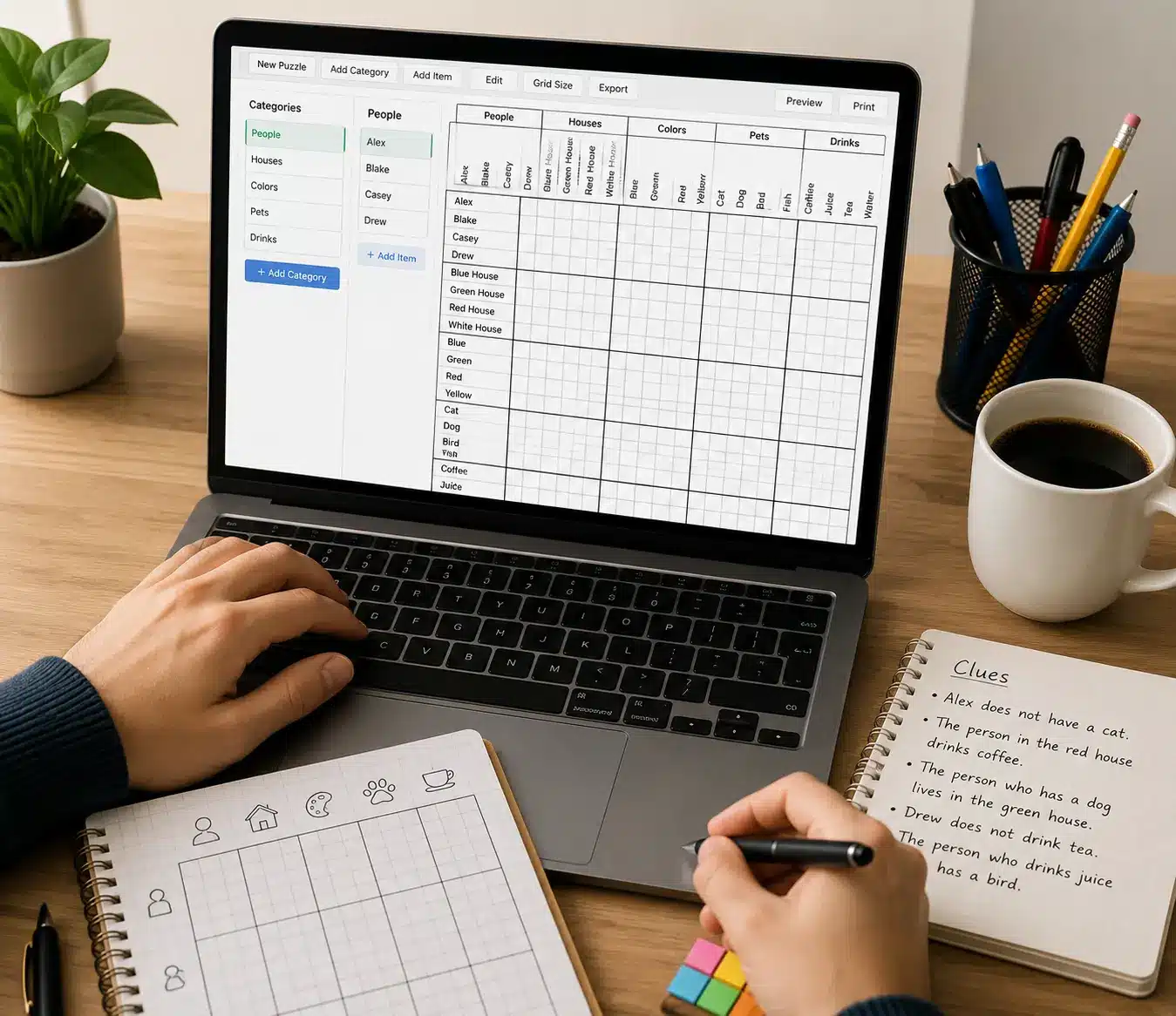
Logic-grid puzzles are among the most useful formats for gifted learners.
The solver receives several categories and a collection of clues. Possible and impossible matches are recorded in a grid until every item has been correctly connected.
A puzzle may ask students to match:
- Four people
- Four pets
- Four houses
- Four favorite foods
Beginner puzzles contain direct clues, while advanced versions rely on relationships between several clues.
These puzzles develop organization, reading comprehension and deductive reasoning. They also teach students to separate confirmed facts from temporary possibilities.
Number Puzzles
Number puzzles include sequences, magic squares, missing-number challenges, arithmetic arrangements and problems involving numerical properties.
A strong number puzzle should require reasoning rather than lengthy calculation.
For example, students may be asked to place a set of numbers in a grid so that every row has the same total. Advanced learners can then be challenged to find all possible arrangements or prove that only one solution exists.
This adds depth without simply increasing the size of the numbers.
Sudoku
Sudoku requires numbers or symbols to be placed so that every row, column and region follows a fixed rule.
The puzzle develops elimination, attention and constraint-based reasoning.
Gifted students may enjoy variations such as:
- Diagonal Sudoku
- Killer Sudoku
- Irregular Sudoku
- Symbol Sudoku
- Greater-than Sudoku
- Multi-grid Sudoku
Students should be encouraged to explain why a number must occupy a particular square. This turns the activity into a reasoning exercise rather than repeated guessing.
Visual Puzzles
Visual puzzles use shapes, colors, reflections, rotations and spatial relationships.
A student may need to identify the next image in a sequence, find the figure that does not belong or determine how a shape will appear after being rotated.
These activities can be especially engaging for visual-spatial learners.
They also balance puzzle collections that depend heavily on reading or numerical reasoning.
Spatial Challenges

Spatial puzzles require students to imagine positions, movements and three-dimensional objects.
Examples include:
- Cube nets
- Tangrams
- Block arrangements
- Folding puzzles
- Route planning
- Symmetry challenges
A cube-net puzzle may show six connected squares and ask whether they can fold into a cube. A route puzzle may require the player to visit every point without repeating a path.
These activities strengthen mental visualization and geometric reasoning.
Truth Puzzles
Truth-and-lie puzzles introduce characters who speak under particular rules.
One character may always tell the truth, another may always lie and a third may alternate between truthful and false statements.
Students must test the consistency of each possibility.
Instead of accepting statements immediately, they ask:
What would happen if this statement were true?
Would it contradict another clue?
Advanced versions can contain several speakers and multiple layers of uncertainty.
Code-Breaking
Code-breaking puzzles replace letters, words or numbers with hidden symbols.
Students may decode a message by examining repeated symbols, letter frequency or relationships between different parts of the code.
Cryptarithms are a mathematical variation in which letters represent digits. Each letter must always represent the same digit, and the final calculation must be correct.
These puzzles combine language, mathematics, pattern recognition and deduction.
Mystery Puzzles
Deductive mysteries present clues within a story.
Students may examine witness statements, timelines, maps or physical evidence to determine what happened.
This format works well for learners who enjoy reading and storytelling. It also introduces the idea that not all clues have equal value.
One clue may prove a fact, while another may only suggest a possibility.
Students must decide which evidence is reliable and how different pieces of information connect.
River Crossings
River-crossing puzzles ask players to transport people, animals or objects while following strict rules.
A boat might hold only two passengers. Certain characters cannot be left together, and only some passengers may be able to operate the boat.
The solution requires a sequence of legal moves.
These puzzles encourage forward planning. A move that appears useful now may make the puzzle impossible several steps later.
Students learn to consider both immediate and long-term consequences.
Coding Puzzles
Coding puzzles introduce algorithmic thinking without always requiring a computer.
Students may:
- Arrange instructions in the correct order
- Predict the result of a process
- Identify an error in a sequence
- Create rules for moving through a maze
- Use conditions such as “if” and “then”
These puzzles develop an understanding of sequence, repetition, cause and effect, input and output.
They can provide a helpful introduction to programming concepts before students begin using a formal coding language.
Lateral Thinking
Lateral-thinking puzzles ask students to question an obvious interpretation.
The solution may require viewing the situation from a different angle or recognizing an assumption that was never part of the original problem.
These puzzles should still be fair. A satisfying solution should make sense when all the clues are considered.
The goal is not to surprise students with a random answer. It is to show how hidden assumptions can limit reasoning.
Play Now
Try this short puzzle.
Four students—Ayaan, Emma, Noah and Sofia—completed four different challenges:
- Sudoku
- Code puzzle
- Logic grid
- Shape puzzle
Use the clues to match each student with the correct activity.
- Ayaan did not complete the Sudoku or shape puzzle.
- Emma completed the number-based puzzle.
- Noah did not complete the logic grid.
- Sofia completed the shape puzzle.
- Noah did not complete the code puzzle.
Pause here and solve it before checking the answer.
Start with the direct clue: Sofia completed the shape puzzle.
Emma completed the number-based activity, so she completed the Sudoku.
Ayaan cannot have the Sudoku or shape puzzle. The two remaining options are the code puzzle and logic grid.
Noah cannot have the logic grid or code puzzle according to the clues. However, this creates a contradiction because his only remaining choices were already assigned.
That means the clues, as written, cannot produce a valid one-to-one solution.
This example demonstrates an important gifted-level skill: checking whether a puzzle itself is logically consistent.
Now change clue three to:
Noah did not complete the code puzzle.
Remove clue five, and the puzzle becomes solvable:
Ayaan — Code puzzle
Emma — Sudoku
Noah — Logic grid
Sofia — Shape puzzle
Spotting a faulty clue can require as much reasoning as solving a correct puzzle.
Choosing Difficulty
A puzzle is not suitable for gifted students merely because it takes a long time.
Repetitive calculation may be time-consuming without requiring deep thought.
Look for challenges that contain:
- Several connected conditions
- A clear but non-obvious solution
- More than one possible starting point
- Opportunities to compare methods
- A need to explain the reasoning
- Extensions for students who finish early
Difficulty should also match the individual learner.
A student may be advanced in numerical reasoning but need more support with verbal clues. Another may excel at visual puzzles while finding multi-step arithmetic challenging.
Gifted learners are not all alike, so puzzle selection should remain flexible.
Using Hints
Hints should guide attention without revealing the answer.
A weak hint says:
“Place Sofia in the second position.”
A better hint asks:
“Which clue gives you definite information about Sofia?”
Useful prompts include:
- What do you know for certain?
- Which option can be eliminated?
- Have you used every clue?
- What happens if that assumption is true?
- Can you draw the information differently?
- Where does a contradiction appear?
These questions help students continue thinking independently.
Explaining Solutions
The answer should not be the end of a puzzle activity.
Students should be asked to explain how they reached it.
They might identify the clue that produced the first important deduction, describe a failed strategy or compare their method with another learner’s approach.
Questions such as “How do you know?” and “Could another answer work?” make reasoning visible.
A correct answer without an explanation may have come from guessing. A clear explanation shows that the learner understands the structure of the puzzle.
Group Solving
Logic puzzles can be completed individually or in groups.
Individual work develops independence and allows learners to move at their own pace.
Group work adds communication, negotiation and collaborative reasoning.
Useful roles include:
Reader: Reads each clue carefully.
Recorder: Marks possibilities and eliminations.
Checker: Looks for errors or contradictions.
Explainer: Summarizes the group’s reasoning.
The activity should be managed so that one fast student does not solve everything while the rest of the group watches.
Every learner should have an opportunity to suggest, question and defend ideas.
Creating Puzzles
Designing a puzzle can be more demanding than solving one.
Students must create conditions that are clear, consistent and sufficient. They also need to test whether the puzzle has one solution or several.
A simple creation process is:
- Choose three or four categories.
- Decide the completed arrangement.
- Write two or three direct clues.
- Add relational clues.
- Remove any clue that makes the answer too easy.
- Ask someone else to test the puzzle.
- Correct contradictions or unclear wording.
This activity combines writing, planning, reasoning and attention to detail.
It also helps students appreciate how carefully a fair logic puzzle must be constructed.
Online Puzzles
Online logic puzzles can provide immediate feedback, adjustable difficulty and a regular supply of fresh challenges.
They are useful for independent practice, especially when students can select an appropriate level.
However, timers and scores should not become the main measure of success.
A student who takes longer but explains each deduction may demonstrate stronger reasoning than someone who finishes quickly through repeated guessing.
A useful online puzzle should have clear instructions, limited distractions and a way to review mistakes.
Printable Puzzles
Printable puzzles allow students to underline clues, draw diagrams and keep a visible record of their reasoning.
They work especially well for:
- Logic grids
- Number sequences
- Mazes
- Code-breaking tasks
- Spatial challenges
- Deductive mysteries
Worksheets should provide enough room for notes and corrections. A difficult puzzle should not become frustrating simply because the page is cramped.
Printable activities are also helpful when families or teachers want a screen-free option.
Common Mistakes
One common mistake is giving gifted students puzzles only after they finish a large amount of repetitive work.
This can make enrichment feel like a punishment for working quickly.
Appropriately challenging activities should be included as part of regular learning whenever possible.
Another mistake is focusing too heavily on speed. Giftedness does not mean that every learner solves every problem immediately.
Some gifted students are reflective thinkers who need time to compare possibilities and test several interpretations.
Adults should also avoid helping too quickly. A short period of uncertainty can be productive.
Finally, logic puzzles should not replace a complete gifted curriculum. Advanced learners also need rich subject content, creative projects, meaningful discussion and opportunities to explore personal interests.
Final Thoughts
Logic puzzles for gifted students offer much more than a way to fill spare classroom time.
They encourage learners to notice patterns, organize information, question assumptions, test possibilities and support conclusions with evidence.
Different formats develop different strengths. Logic grids improve deduction, number puzzles build pattern recognition, spatial challenges support visualization and mysteries strengthen evidence-based reasoning.
The best puzzles are clear, fair and difficult enough to require sustained thought.
A correct answer completes the activity, but the most valuable learning happens during the process: reading closely, making mistakes, changing strategies and explaining why the final solution works.
FAQs
What are logic puzzles for gifted students?
They are structured challenges that use clues, patterns and rules to develop advanced reasoning and problem-solving skills.
How do logic puzzles benefit gifted learners?
They strengthen deduction, concentration, flexible thinking, persistence, pattern recognition and confidence when approaching unfamiliar problems.
Which logic puzzles are best for gifted students?
Logic grids, Sudoku, code-breaking challenges, number patterns, visual puzzles and deductive mysteries are all useful choices.
How often should gifted students solve logic puzzles?
A few thoughtful sessions each week can provide useful practice without making puzzles feel repetitive or compulsory.
Should gifted students solve puzzles alone or in groups?
Both approaches are valuable. Individual work builds independence, while group solving develops communication and collaborative reasoning.